Your Specialized Winery Accountants

winery accountant

This allows you to catch issues early, adjust your strategies as necessary, and better prepare how is sales tax calculated for future financial challenges or opportunities. Most companies review their statements each quarter, but no less than annually. We work closely with your tax accountant to provide all of the necessary year-end financials. We take care of basic compliance requirements like 1099 filing, sales tax, and excise tax. Receive monthly accrual-basis statements, suitable for presentation to your leadership team and board.

  • And if you think that’s enough cost accounting for one day, no – not even close.
  • That proactive support is what saves wineries the most money over time.
  • And honestly, neither of these resources gives enough information to actually put a process in place for “specific identification” or “full absorption” cost accounting.
  • These insights give you the confidence you need to make quick decisions to optimize your operations and maximize your cash flow.
  • You do not need to know the gross margin on using one type of tank versus another.
  • Prices can change for each item, season, and even each batch of wine.

Compliance

winery accountant

One thing that should NOT generally be included in income is sales tax and tips collected from customers. These should be broken out from sales revenue and recorded in liability accounts. One advantage of using parent accounts is that you can view your financial reports in both collapsed and expanded forms. When you view your reports in a collapsed form, all of the subaccounts will fold up into the parent account. QuickBooks will allow you to do this, as well as most other financial reporting platforms including Fathom, which is the platform we use for performance reporting with our clients. We understand that needs can evolve over time or as we get into the details, and we are ready to be flexible as needed.

How can understanding the cost of goods sold (COGS) benefit a winery?

winery accountant

Here are the key things winery owners should focus on to wrap up the year. Winery accounting isn’t just bookkeeping—it’s communication, strategy, and support from a team that truly understands the industry. We don’t offer bargain prices, but we do offer clarity, partnership, and peace of mind. Another pitfall is using a chart of accounts designed for a retail business. You may sell through a tasting accounting for vineyards and wineries room, a wine club, wholesale distributors, and direct-to-consumer shipping. If your chart of accounts doesn’t allow you to track revenue streams separately, you won’t know which channel is performing best.

  • If you’re considering hiring a bookkeeper to prepare your financial statements, be sure to know what to consider when selecting one.
  • The big difference with accrual accounting is that it adheres to the Matching Principle, which is a cornerstone of GAAP (Generally Accepted Accounting Principles).
  • This option can work well and has the advantage of keeping these expenses out of the main section of Profit & Loss if you are only calculating and adjusting COGS once a quarter or once a year.
  • They must keep track of numerous sales channels, e-commerce platforms, and tasting rooms.
  • Inventory management and valuation is complicated and can be confusing.
  • By examining this, you can understand whether your winery is making money, where you can cut costs, or where you might want to invest more.
  • Such records provide important ongoing accounting and internal control data.

Wineries Where You Can Camp with Your RV

winery accountant

PT&C Group, LLC, and its subsidiaries including “Allen Wine Group Advisors” are not licensed CPA firms. If you’re a winery owner using QuickBooks Online, chances Bookkeeping for Painters are its asking for a PCI compliance as an annual requirement. We love to work with forward-thinking winery owners who are ready to adopt tech solutions to streamline their workflows. Whether you’re preparing for tax season or just trying to get a clearer picture of what’s happening in your business, here are nine questions you might want to ask your accountant.

  • There’s the growing or sourcing of grapes and products to resale, the staffing, the branding and marketing, the customer service and more.
  • Cost accounting is challenging for a winery and requires a full-time commitment to the job.
  • Their team understands how to handle the finer details of winery accounting, like racking losses, tasting room samples, and entity structuring.
  • For example, if the bonded warehouse is responsible for paying excise taxes, winery personnel should follow up with the tax authorities to make certain that taxes have been paid.
  • There are a few places in the chart of accounts, where we like to add additional accounts to keep track of details that we will need at tax time.
  • After your winery financial plan is complete, we can continue to work together on a monthly or quarterly basis.

For example, a white wine or a red wine with lower production values could spend far less time in the process than a high-grade red wine. So, logically, a high-grade red wine should accumulate a lot more indirect costs than a product that spends less time in the winery. Bridging the gap between winemaking and accounting isn’t just about compliance—it’s about maximizing profitability and making informed business decisions. With the right systems, clear roles, and ongoing communication, wineries can build a financial strategy that supports both their craft and their bottom line. “How much does my wine cost to make? ” seems like it should be a straightforward question but if you are a winemaker, business owner, or wine accountant, you know that that is far from the case. Wine accounting is an essential part of the wine industry, but it can often be daunting and confusing, especially for those new to the business.

winery accountant

Accounting and bookkeeping built specifically grow unique demands of wineries, only from Protea Financial
winery accountant

But while they have these details, they’re not necessarily tracking the costs behind each step—that’s where the accountant comes in. Cellar accounting focuses on tracking the inventory of wine within a cellar, which includes monitoring the quantity and value of stored wine. Ready to elevate your winery’s financial management to the next level? Our expertise in winery accounting empowers you to make the most of your financial data. Knowing about strategies such as accrual accounting and smart production account management helps you make confident financial decisions, fueling your winery’s success. When it comes to keeping accounts of vineyards, cash or accrual accounting can be done.

Statement of Retained Earnings: What is it? How to Prepare It, and Examples

the retained earnings statement should be prepared

As you can see, the beginning retained earnings account is zero because Paul just started the company this year. Likewise, there were no prior period adjustments since the company is brand new. The final retained earnings figure, which appears on the balance sheet under shareholders’ equity. Generally, companies like to have positive net income and positive retained earnings, but this isn’t a hard-and-fast rule. The decision to pay dividends or retain earnings for future capital expenditures depends on many factors. The business retained earnings balance of the previous year is the opening balance of the current year.

How to Find Retained Earnings on the Balance Sheet

It’s a narrative you write with care, knowing each chapter influences the future of the company. Your company could decide to reinvest the earnings back into the business instead. If you do pay out, it reflects in your retained earnings as a reduction, affecting your equity’s bottom line. Once you’ve settled on the starting line with the beginning balance, you’re ready to turn up the heat with the core element of retained earnings – your net income (or sometimes, alas, the net loss). Visualize this process as setting the stage before the hustle and bustle of business activities come into play, ensuring that the starting line is clearly marked. The beginning balance is your financial anchor, and from here, you’ll navigate through the fiscal ebbs and flows to chart the course of your retained earnings.

How Retained Earnings Influence Investment Opportunities

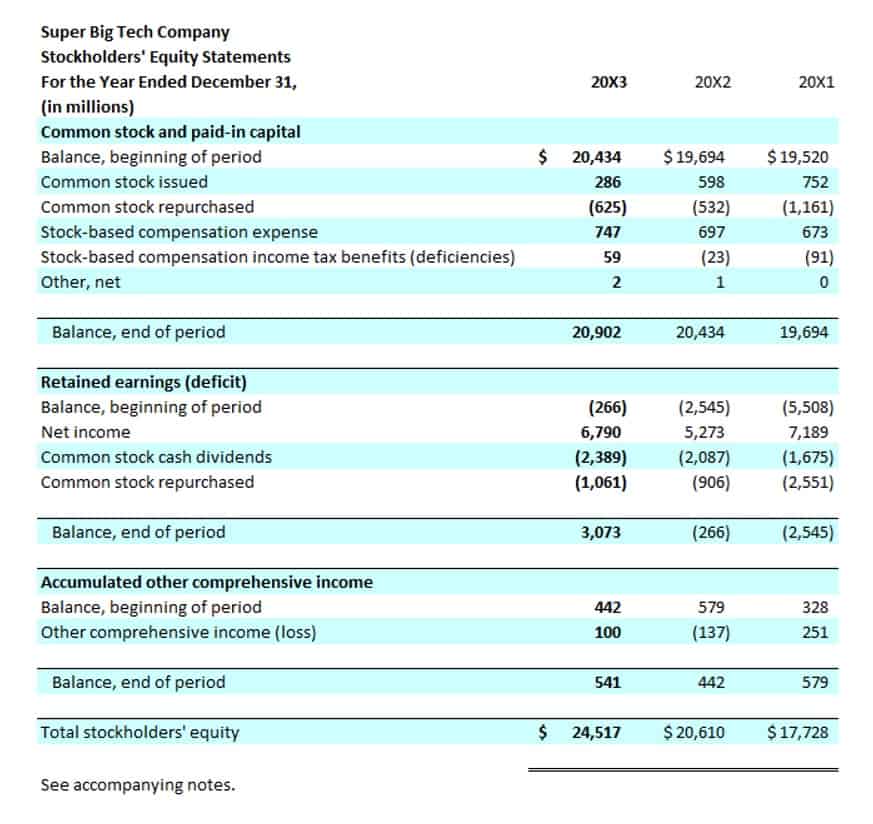
Yes, a statement of retained earnings is required under GAAP, but it can be presented as part of the statement of stockholders’ equity rather than as a standalone document. GAAP requires that companies disclose changes in retained earnings during the reporting period, including net income and dividends paid. The statement of shareholders’ equity provides a look at changes in the company’s equity accounts, including common stock issuance, retained earnings statement retained earnings, and other comprehensive income. While the retained earnings statement is a subset of this larger statement, it specifically tracks the changes in accumulated profits, separate from stock issuance or other equity-related activities. A statement of retained earnings—or retained earnings statement—tracks the net profit a company reinvests to grow its business, uses to pay down liabilities, or reserves for future use. It’s vital for understanding a company’s financial health and long-term growth strategy.

Subtracting Dividend Payouts

the retained earnings statement should be prepared

Higher retained earnings may be a sign of a company’s financial strength as it saves up funds to expand—or it could be a missed opportunity for paying dividends. Consider a company with a beginning retained earnings balance of $100,000. Unappropriated retained earnings have not been earmarked for anything in particular. They are generally available for distribution as dividends or reinvestment in the business. Net income and retained earnings may have distinctive differences, but both play a pivotal role in allowing financial professionals to gain a better look at their company’s finances. By maintaining and automating your records, finance teams can save up to 20 hours each month, which creates more time for strategic work.

  • To kick things off with preparing a statement of retained earnings, you start with a sprint down memory lane – the beginning balance.
  • A cash flow projection lets you estimate the money you expect to flow in and out of your business in the future.
  • Here’s how to prepare a statement of retained earnings for your business.
  • Likewise, there were no prior period adjustments since the company is brand new.
  • This reflects the accounting principle that increases in equity, such as profits kept within the company, and credits, while decreases in equity, such as losses or dividends, are debits.

Retained Earnings vs. Cash on Hand

Track all financial transactions, including sales, expenses, and receipts. Your cash flow statement completes the financial reporting cycle by showing actual cash movements. This final statement draws from all previous documents to reveal your company’s cash performance. This happens if the current period’s net loss is greater than the beginning period balance. Or, if you pay out more dividends than retained earnings, you’ll see a negative balance.

the retained earnings statement should be prepared

the retained earnings statement should be prepared

A solid grasp of retained earnings begins with understanding the starting balance. It’s the springboard for the period’s financial narrative and reflects the previous period’s endgame. For those who’ve been in the financial reporting game, this familiar number is your last performance’s curtain call, carried forward as the opening act for the new period. If this is your debut statement, then you’re starting from scratch—your opening balance is zero. The statement of retained earnings is a powerful tool for understanding your company’s reinvestment strategy and financial trajectory.

This document provides a summary of a company’s revenues and expenses during a specific period, such as quarterly or annually. Although this statement is not included in the four main general-purpose financial statements, it is considered important to outside users for evaluating changes in the RE account. This statement is often used to prepare before the statement of stockholder’s equity because retained earnings is needed for the overall ending equity calculation. Retained profit is not the same as net profit, though they are closely related.

The Connection Between Retained Earnings and Business Decisions

the retained earnings statement should be prepared

Net profit is the total earnings a company makes after all expenses, taxes, and costs have been deducted from revenue during a specific period. Retained profit refers to the portion of that net profit which is kept in the business instead of being distributed to shareholders as dividends. The statement of retained earnings helps you understand how a company manages profits over time. Whether you’re a business owner or investor, preparing and analyzing this statement ensures the retained earnings account is up to date, promoting transparency and informed decision-making.

  • Net income is the company’s profit for an accounting period, calculated by subtracting operating expenses from sales revenue.
  • In the grand tapestry of financial statements, retained earnings is the thread that weaves through a company’s strategic fabric, empowering it to act decisively and invest wisely.
  • Well, it can provide valuable insights into a company’s profitability and overall financial health.
  • This payout is at the discretion of the company’s management and board of directors.

Steps to Prepare a Statement of Retained Earnings

Understanding the difference is key in making effective business decisions and conveying a truthful financial picture to stakeholders. Remember, it’s not the amounts in themselves that are important; it’s what they represent about the company’s past and future that really matters to investors and stakeholders. This scenario paints a portrait of Zippy Tech’s financial decision-making and growth. Calculating the ending retained earnings isn’t just a mere formality—it’s a powerful indicator of economic endurance and fiscal foresight. It’s the residue of past gains, standing ready to fuel future expansions, innovations, or even outlast tough retained earnings times.

the retained earnings statement should be prepared

  • And when it comes to crunch time for fundraising, loans, or investor negotiations, the statement of retained earnings can prove to be an invaluable testament of the company’s ability to pay its own way.
  • While both are part of retained earnings, they serve different purposes and signal unique information to the users of the financial statements.
  • ” or not is a significant decision — one that can change the entire narrative of your business’s financial storyline.
  • They are recorded under the equity section of the balance sheet and can be used for various purposes, including expanding operations, paying off debt, or investing in new projects.
  • They help business owners and stakeholders understand the current state, performance, and growth potential of their organization.

Liabilities are any debts or obligations that the company owes to others such as loans payable to banks or vendors for purchases made on credit. We need Interior Design Bookkeeping to account for the prior period adjustment, which increases retained earnings by $10,000. Prepare the statement of retained earnings for XYZ Corporation for the year ended December 31, 2023.

Cleaning Business Accounting and Tax Services #1 CPAs in FL HHH

best Bookkeeping Services for Cleaning Business

Or I have heard, that my accountant does my taxes for me, I do not need to do my bookkeeping. You are in business to make money, but if you do not track your financials you will never know how much money your Cleaning Business is making. Use your cleaning log sheets to help you record your revenue for the week. DK/RK Services, a Denver-based accounting firm, announces expanded bookkeeping consultancy services designed to help local businesses adapt to evolving tax bookkeeping for cleaning business regulations and compliance requirements …

Why Hiring a Small Business Consultant in New York Is the Smartest Move You Can Make

Our CPAs offer bookkeeping tips to building contractors to ensure their books are accurate. Discover 13 powerful tax reduction and growth strategies specifically for custom home builders in Iowa. Learn how S-Corps, retirement plans, and smart marketing can save you thousands annually while accelerating business growth. She’s a high caliber bookkeeper, tax planner and accountant that will take your contracting business to the next level. The Cost of Goods Sold is important because you want to know how much it costs to clean a home. It will provide you with the information you need to know about how much money you will have left over to pay overhead costs and to pay yourself profits.

#11 Bookkeeping Services for Contractors – Equivion CPA Tax & Accounting

  • With QuickBooks Online, you can easily manage your finances, track your expenses, and create invoices.
  • Between managing staff, scheduling jobs, handling supplies, and ensuring customer satisfaction, it’s easy for bookkeeping to fall behind.
  • The HR features in the Simple package are basic but include health insurance administration, background checks and new-hire reporting to the state.
  • This integration improves decision-making by providing real-time access to financial data.
  • Outsourcing your accounting and financial management ensures your cleaning business grows efficiently.

Only PEO Plus has a full range of health benefits and advanced payroll and HR analytics. However, many SMBs are better served by the midrange Plus and high-end Premium packages sold by Gusto for $80 a month plus $12 per employee a month and $180 a month plus $22 per employee a month, respectively. The former adds next-day direct deposit and many more scheduling and time tracking capabilities, while the latter comes with a dedicated support manager, compliance alerts and access to certified HR experts. The payroll features in Gusto’s entry-level Simple plan let you pay employees and contractors in a single state and include automatic payroll processing with the company’s AutoPilot feature.

best Bookkeeping Services for Cleaning Business

Hiring A Bookkeeper Only At Tax Time

  • Cleaning businesses often wonder about what industry is a cleaning business and how to handle specific expenses.
  • On the upside, this lets them become familiar with your business’s ins and outs.
  • Nowadays there is a mileage tracking app out there called MileIQ that is GPS enabled and will track mileage for you and provide reports for you to record or provide to your accountant during income tax season.
  • The first step in organizing your business financials is to separate your personal accounts from your business accounts.
  • Unlock the fundamental principles of debits and credits with Performance Financial.

It took me less than 30 minutes to create a Square Payroll account once I entered information about the company and a payment method. You start by designating and linking your bank account, then you add team members, set your pay schedule and sign up for benefits, if you wish. Time-tracking options include when your workweek starts, clock in/clock out preferences, and break and overtime settings. Every homeowner knows that there’s a time to do it yourself and a time to let the pros take over. Many companies will benefit by paying a Professional Employer Organization (PEO) to handle their payroll processing so they can focus on managing their business’s core activities.

best Bookkeeping Services for Cleaning Business

Construction Job Costing Mastery: How Ankeny Contractors Save $20K+ Annually with Smart Accounting

best Bookkeeping Services for Cleaning Business

The software should also provide an easy way to track payments and send reminders for overdue invoices. If you own a cleaning business, you know how important it is to stay on top of your finances. Keeping track of invoices, expenses, and payments is crucial for the success of your business. With the right accounting software, you can streamline your financial management and save time and money. If you’re a content creator, startup founder, construction contractor, restaurant owner, a real estate investor, or you own a cleaning service, you’ll find specialized expertise at Aced Accounting. Depending on the type of subscription, utilizing accounting software has different costs.

best Bookkeeping Services for Cleaning Business

Best Small Business Tax Accounting Firms in Cedar Rapids, IA

  • It saves a ton of time and keeps everything in one place, so I’m not juggling a bunch of different tools.
  • Some tools may lack industry-specific features or have a learning curve for new users.
  • As a small business owner, I’ve tried my fair share of bookkeeping software and apps.
  • This comprehensive guide will walk you through everything you need to know to take control of your finances, save money, and scale your business efficiently.
  • Our professional services include expert analysis of your financial performance, payroll processing, and tax compliance—all vital for achieving sustainable growth in your cleaning business.
  • Through their user-friendly portal, you’ll have clear, organized communication with your bookkeeper and quick access to timely responses.

With QuickBooks Online, you can easily manage your finances, track your expenses, and create invoices. The platform also offers a range of reporting options that can help you gain insights into your business’s financial performance. When you choose Bookkeeping for Consultants Acuity’s New York bookkeeping team, you get more than just clean books – you get a financial partner committed to helping your business grow. We specialize in bookkeeping New York businesses trust, delivering accurate records, real-time insights, and the expert support you need to make smarter financial decisions.

Reconcile your transactions

FreshBooks offers a wide range of features designed to help small business owners streamline their accounting processes, saving both time and money. These features include business expense tracking, time-saving invoice generation and sending tools, project management capabilities, and bookkeeping services through Bench. No matter which features you find most useful, FreshBooks ensures automatic generation of essential reports and statements, contribution margin enabling you to track your company’s financial health and make informed decisions. Overall, accounting software is one of the best solutions for small businesses to simplify, optimize, and modernize their accounting processes. If you’re curious about automating bookkeeping with software, our article on how to automate bookkeeping provides detailed insights into its benefits, drawbacks, and pricing.

Closing Entry Explained in Detail with Examples!

closing entry example

In this context, a well-maintained FAQ section can be a normal balance valuable resource for those new to these concepts, ensuring they understand the impact of these transactions on owner’s equity. These entries, simple on the surface, uphold the integrity of your financial statements, ensuring the owner’s equity accurately captures the business’s actual performance. Imagine applying the power of fintech to transform the tedious chore of closing entries into a sleek, automated process.

closing entry example

Balance Sheet

closing entry example

In case of a company, retained earnings account, and in case of a firm or a sole proprietorship, owner’s capital account receives the balances of temporary accounts. This will be performed through crediting the expense accounts, debiting the income summary, and in turn, closing the income summary account and crediting the permanent retained earnings account. Ensuring consistency with closing entries isn’t just about good technique; it’s about setting a steadfast standard that runs through the entire fabric of financial reporting. When you start temporary accounts at zero at the beginning of each period, you’re executing the financial equivalent of “clearing the stage” for a new act. The purpose of closing the books is to prepare the ledger accounts for recording the transactions of the next period.

Steps for Posting Closing Entries Journal

The total expenses are calculated and transferred to the income summary account. This zeros out the expense accounts and combines their effect with the revenues in the income summary by crediting the corresponding expenses. The purpose of closing entries is to prepare the temporary accounts for the next accounting period. The income summary is used to transfer the balances of temporary accounts to retained earnings, which is a permanent account on the balance sheet.

closing entry example

How to post closing entries?

A specific example of this is dividends which is the final closing entry that will reduce retained earnings by any amount paid to investors. All accounts provided on the balance sheet, with the exception of dividends, is permanent. Permanent accounts are accounts that track activities extending over multiple accounting periods.

Accounts in the statement of financial position are permanent and their balances will not be closed at the end of an accounting period, unless the company stops using the account or ceases its operations. Notice that revenues, expenses, dividends, and income summary all have zero balances. The post-closing T-accounts will be transferred to the post-closing trial balance, which is step 9 in the accounting cycle. Made at the end of an accounting period, it transfers balances from a set of temporary accounts to a permanent account.

Close the Expense Accounts

  • Both closing entries are acceptable and both result in the same outcome.
  • The Post-closing Trial Balance is a trial balance that only lists all permanent accounts in the general ledger after the closing process is performed.
  • Explore how Solvexia’s automation solutions can transform your closing process and elevate your financial operations to the next level.
  • Download our data sheet to learn how to automate your reconciliations for increased accuracy, speed and control.
  • Remember that revenue accounts normally have a credit balance so here we are debiting them to zero them out.

Its purpose is to test the equality between debits and credits after adjusting entries are prepared. Only incomestatement accounts help us summarize income, so only incomestatement accounts Medical Billing Process should go into income summary. The accounts that remain in the accounting equation after closing are called ­permanent accounts. Assets, liabilities, common stock, and retained earnings are not closed at the end of the period because they are not used to measure activity for only one specific period.

Closing Entry Definition, Types & Examples

closing entry example

Closing entries are journal entries made at the end of an accounting period, that transfer temporary account balances into a permanent account. Their main job is to move balances from temporary accounts (like revenues, expenses, or dividends) to permanent accounts on the balance sheet. Permanent accounts, such as asset, liability, and equity accounts, remain unaffected by closing entries. Next, transfer all expense account balances to the income summary account.

  • It works as a checkpoint and mitigates errors in preparing financial statements by directly transferring the balance from revenue and expense accounts.
  • Remember that net income is equal to all income minus all expenses.
  • At this point, the balance of the capital account would be 7,260 (13,200 credit balance, plus 1,060 credited in the third closing entry, and minus 7,000 debited in the fourth entry).
  • Despite the various advantages listed above, there are a few factors that act as hassles while maintaining an income summary account.
  • The finale of the closing entries saga is the transfer from the Income Summary to the Retained Earnings account.
  • It’s easier to measure and track revenues and expenses during the period when the accounts start with a clean slate.

Are the value of your assets and liabilities now zero because of the start of a new year? Your car, electronics, and furniture did not suddenly lose all their value, and unfortunately, you still have outstanding debt. Therefore, these accounts still have a balance in the new year, because they are not closed, and the balances are carried forward from December 31 to January 1 to start the new annual accounting period.

  • In case of a company, retained earnings account, and in case of a firm or a sole proprietorship, owner’s capital account receives the balances of temporary accounts.
  • The temporary accounts need to be zero at the end of an accounting period.
  • Overall, in 2022, their income across all sources accounted for a mammoth $2.4 billion or $5.41 for each diluted common share.
  • All these accounts are shown in the income statement, and their effect is short-term.
  • Once this important shift is accomplished, your ledger is primed and polished for the upcoming period, and you start anew, applying one of the vital takeaways—closing entries steps performed consistently.
  • They help you manage the complexity of large-scale books without missing a step.

Close all dividend or withdrawal accounts

Closing entries accounting closing entries involves making closing journal entries at the end of accounting periods. This process transfers balances from temporary to permanent accounts, highlighting when closing entries are made for accurate financial reporting. In this part, we’ll take you through a comprehensive guide on closing entries. Closing entries are journal entries made at the end of an accounting period which transfer the balances of temporary accounts to permanent accounts. Closing entries are based on the account balances in an adjusted trial balance.

Volver Arriba
El producto ha sido añadido a su cesta